

Lando's Sabacc Reading
Updated: Apr 19
An Analysis of Lando Calrissian's Sabacc Card Fortune Reading in The Mindharp of Sharu

"Did you know, old pentapod, that these things were once used for telling fortunes?"
He shuffled the deck again, cut it, and began laying the cards out on the floor
"Highly irrational and unscientific, Master."
— Lando Calrissian & Vuffi Ra, The Mindharp of Sharu
In the Star Wars Legends novel Lando Calrissian and the Mindharp of Sharu, Lando performs an Oracle reading during a journey to the heart of an ancient Sharu monolith. He interprets the cards for his co-pilot, the pentapod droid known as Vuffi-Ra, who is naturally sceptical about the merits of fortune telling.
In this post, we'll explore Lando's reading and how it draws upon the Tarot as a direct pattern both for the reading itself and the identities of the cards that the author L. Neil Smith describes in the Sabacc deck. Though there are numerous clues in The Mindharp of Sharu that the Sabacc deck a re-skinned tarot deck, it is the fortune-telling scene that makes this most explicit.
In the text of the novel, Lando appears to draw 10 cards. These cards correlate with the positions of a Celtic Cross spread, seen here in a page from The Pictorial Key to the Tarot by A.E. Waite.
The Rider-Waite Tarot was first published by William Rider & Son in 1909, with a text written by the academic and mystic Arthur Edward Waite, and cards illustrated by Pamela Coleman Smith, both of whom were members of the Hermetic Order of the Golden Dawn. It was republished many times, and is one of the most widely circulated and recognised versions of the Tarot ever published, with over 100 million copies of the deck thought to have been sold across 20 countries.
Studying L. Neil Smith's depiction of Lando's Sabacc Oracle in The Mindharp of Sharu shows a very close correlation between the Celtic cross method as it appears in his book, and the meanings that he gives to his Sabacc cards. In this post, we'll analyse each part of the reading to make the connection clear. The wide distribution of the Rider-Waite Tarot makes it very plausible that L. Neil Smith was working from a copy of this deck and text, or another version that was based very closely upon it.

To the right you'll see our recreation of the 'Celtic Cross' layout for Lando's Sabacc reading. At the end of the post, we'll discuss some changes to this setup that help to adapt the Tarot spread and directly integrate it into Star Wars lore.
Establishing the one-to-one relationship between the Rider-Waite Tarot and the Sabacc Oracle is also the basis for building out the rest of the Oracle Deck cards which are not covered in the official lore, and creating our own version of the Sabacc deck that can be used for roleplaying in the Star Wars universe!
THE FIRST CARD: THE SUBJECT OR 'SIGNIFICATOR'

The first card in a Celtic Cross is called the 'Significator' in Rider Waite's book. This means that the card represents the subject of the reading. Another common name is the 'Querant', or whoever is 'asking the question'. In our own Sabacc Oracle lore, we call this position he Protagonist or 'The Seeker'.

Lando's reading starts with a card he recognises as himself:
The first card to fall was the Commander of Staves, one which Lando had often associated with himself. It was the apparently chance appearance of the right card- as happened so often - that made him wonder if his "scientific" analysis was all there was to the things.

The Commander of Staves maps directly onto the Knight of Wands in the Rider-Waite Tarot. Waite's book says of the Knight that they are, 'although mailed, not on a warlike errand'. When he sees the card Lando says:
"That's me," he explained to the robot, "a messenger on a fool's errand."
As well as the suggestive echo of 'errand', there's another interesting detail here: the Knight is 'passing mounds or pyramids'. Lando is currently on a journey into the heart of one of the Sharu monoliths, elsewhere described as pyramids. The Knight is also said to be 'a dark young man, friendly'. If Smith was guided by Waite's description, it's a very good match to Lando!
The detail of the pyramids in the background also makes me wonder if Smith used the tarot cards themselves as a creative tool or prompt when he was coming up with the plot for The Mindharp of Sharu: perhaps his tale started with a creative consultation of a tarot deck, and picking out the Knight of Wands to represent Lando.
While Lando takes the Significator to directly represent him, in a Celtic Cross the card can more generally signify the 'the influence which is affecting the person or matter of inquiry generally'. Since it can indicate the Querants situation, it does not follow that a person has to closely associate their whole person with the card that goes down in this place!
THE SECOND CARD: THE OBSTACLE/ANTAGONIST

The next card in a Celtic Cross is laid across the top of the first and shows, according to Waite, 'the nature of the obstacles in the matter'. Lando signals this before drawing his next card:

"Let's see what stands in the way." He dealt a second card and laid it across the first "Great Gadfry!" he exclaimed.
"What is it, Master?"
"Not what, who. It's Himself - The Evil One. I'd guess that to be Rokur Gepta.
Rokur Gepta is the antagonist of The Mindharp of Sharu - a 'Tund sorceror' who seeks the Mindharp for himself. The card Lando draws he calls 'The Evil One', and is Smith's version of The Devil. This identification is fairly straight forward, and we don't need to delve into the more subtle meanings of the Devil appearing in a reading! Here, it pretty much means 'The Bad Guy'.

In our Sabacc Oracle, the decades of Star War lore that comes after The Mindharp of Sharu allows us to sharpen this card's identity to something more specific : we call it 'The Bogan', after the moon on ancient Tython which became directly associated with The Dark Side of the Force, opposite its counterpart Ashla, which represented the Light. In the manner of celestial bodies which became identified with (and avatars for) primal spiritual forces, the Bogan easily stands in as an embodiment of evil, and we can even imagine denizens of the Star Wars universe calling malignant entities 'bogans' in the same way that our culture generalised 'devils' to demonic spirits in our world.

And then Smith uses the twist that Sabacc cards randomly change their face to get two cards into this position:
"Hold on, now, it's changing.
As sabacc card-chips are prone to do now and again, the second transformed itself into the Legate of Coins - but the image was upside down.
"Duttes Mer!" laughed Lando "A being corrupt and evil if ever there was one! Well, that makes sense, even though it tells us nothing new. Let's see what else."

The Legate of Coins is The Page of Pentacles. Lando pegs him instantly as the other villian of the story, the corrupt official Duttes Mer, who is blackmailing him into finding the Mindharp of Sharu. The card is upside down, or 'Reversed' in Tarot terminology. Reversed, the Page of Pentacles stands for the opposite of its ideal, and is a figure of corruption: 'prodigality, dissipation, liberality, luxury; unfavourable news' in Waite's key. As an 'evil messenger' he is also a reverse mirror to Lando's character as the protagonist.
THE THIRD & FOURTH CARDS: THE CROWN & THE FOUNDATION

The third card in a Celtic Cross is placed directly above the Significator, and represents 'the Querant's aim or ideal in the matter' or 'the best that can be achieved under the circumstances, but that which has not been made actual'. Waite describes this card as representing 'what crowns' the Querant. Smith names this a the protagonist's aims, intent or motivation:
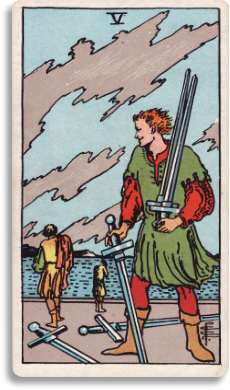
The third card he placed above the others. The Five of Sabres, Lando explained, represented his own conscious motivations, in this case, the desire to relieve the weak and unwary of the burden of their excess cash.
The Five of Swords in the Rider-Waite Tarot shows a man carrying weapons, and several defeated figures retreating. Waite calls him 'the master in possession of the field'. The action of carrying the swords could be interpreted as him collecting the spoils. Most of the meanings associated with the card are fairly negative, suggesting a person with destructive intent, or defeat and victimisation for the losers of the encounter.

It's possible to see this card as depicting a victory for one over the others (the retreating figures), and as such, it represents Lando's mercenary intentions at the Sabacc table. In our own version of the Sabacc Oracle, we call this card 'The Assassins' - to represent a vocation whose rewards come at the direct expense of its victims!
Lando moves quickly on to deal the next card. The fourth card in a Celtic Cross goes under the Querant. Waite calls it 'what is beneath' them. For Waite, it represents 'the foundation of the matter'.
The way that Smith uses the card, however, suggests that the 'foundation' in question is something foundational to Lando's character. It reveals unconscious desires, unacknowledged character traits and motivations, in counterpoint to the Crown card.

He chuckled, dealt a card below the others, indicating his deeper, possibly subconscious motives. He groaned.
"The Legate of Staves. Don't tell me I'm a do-gooder at heart!"

The Legate of Staves is the Page of Wands. Described by Waite as a 'Dark young man, faithful, a lover, an envoy, a postman' who has 'the chief qualities of his suit', it's the younger precursor to the Knight of Wands and thus perfect, thematically, to represent a more idealistic, less jaded version of Lando's character.
Note also how Lando called the Commander/Knight 'a messenger', while it's the Page which Waite actually identifies as 'an envoy, a postman'. This further suggests that the Page represents Lando's true character, while the Knight is only a mask, a more cynical version of himself that he presents to the world.
In our Sabacc Oracle, the Legate of Staves is called 'The Advocate'. While the Commander of Staves represents an envoy or ambassador versed in politics and pragmatism, the advocate stands for a younger political representative motivated to give a voice to others in the affairs of government.
THE FIFTH CARD: THINGS PAST

"Well, the next card should tell us something. It represents the past, things coming to an end.
It was the Six of Sabres. Lando placed it to the left.
"Oh-ho! This usually denotes a journey, but its position indicates the journey is nearly at an end. What do you think of that?"
"I think, Master, that journeys can end in many ways, not all of them pleasant or productive."
The fifth place in the Celtic Cross 'gives the influence that is just passed, or is now passing away'. Waite calls it 'What is behind', making 'The Past' a good summary for this card placing.
In The Mindharp of Sharu, Lando places it on the left side of the Cross. This is actually the opposite side to the diagram in the Waite book, which places it on the right. However, the instructions in the book say the card should be placed 'on the side of the Significator from which he is looking' - a reference probably to the figures depicted on the card. The position is reversable, then. Schematically, placing this card on the left feels like the natural position to represent Things Past -as the rest of the cards (representing the future) are laid out on the right of the Cross.

Nevertheless, Lando's reading encompasses the idea that the subject of this card is only passing, rather than fully past: The Six of Sabres is the Six of Swords, which shows a ferryman and passengers crossing a large body of water like a lake or a river. It's a fairly natural card to choose to represent a journey. In other interpretations of the Tarot, however, the figures are also associated with flight and emigration, suggesting that the journey is away from some kind of disaster. The end of the journey is uncertain, as Vuffi Ra reminds Lando.

Our version of the Sabacc Oracle calls this card The Outlanders, representing travelers and strangers arriving to a new place, who may be welcomed with open arms or viewed with fear and suspicion. They are represented not by boats, but by wings, capturing the migratory theme, and more symbolic of the extra-terrestrial and inter-galactic nature of travel in the Star Wars universe.
THE SIXTH CARD: THE PATH AHEAD

The Sixth Card in the Celtic Cross represents the path ahead, and is the first card that 'predicts' the future. The Celtic Cross diagram puts it on the left; Lando places it on the right, and I think this works better visually and functionally.

The little robot didn't reply, but simply watched Lando lay the next card down to the right of the center pair.
"Flame and famine! You spoiled the run, Vuffi Raa - it's the Destroyed Starship!"
His co-pilot's dour take on the cards, he claims, is spoiling their luck! Vuffi asks if the card means that 'harm will come to the Falcon'? Lando explains it means, less literally:
"Cataclysmic changes in the near future, death and destruction. It may be the worst card in the whole deck. Maybe. One thing I've learned from all this: there's always a worse card."
The Destroyed Starship is probably supposed to take the place of The Tower in the Tarot deck. the sixteenth card in the Major Arcana, the Tower is depicted as being struck by lighting and exploding into flame. It's most apparant surface meaning then, is as Lando says, cataclysm, death and destruction.

Waite ascribes some very lofty meanings to it: 'the materialization of the spiritual word', 'the downfall of the mind, seeking to penetrate the mystery of God', 'the ruin of the House of We, when evil has prevailed therein'. In doing so, he reaches for a double meaning: catastrophe, but perhaps a catastrophe for worldly and vain ambitions. Thus it might signal material disaster, but spiritual rebirth: the harbinger of change for someone who has 'built their house upon the sand'.

While Smith clearly introduced the Destroyed Starship as a version of the Tower, our own Sabacc Oracle moves it's position in the deck to make it cognate with The Chariot. Ours is not the first deck to do so, and it's done simply because the idea of a Starship matches up much better with the Chariot card, while the Star Wars universe certainly holds enough examples of temples, towers and spires to support a card with that identity (most choose 'The Spire'). Just as 'The Tower' is not directly called 'The Destroyed Tower', we call this card 'The Starship', with the option of including elements of destruction, dereliction or loss in the symbolic card art.
This change need not spoil the sense of Lando's reading - The Chariot, also, can be interpreted as warning of possible disaster. Waite's book makes it a figure of mastery - the charioteer, controlling the animals that draw his cart, represent the intellect ascendent over the natural world. In Waite, these animals are sphinxes which sit docile at his feet. It's a picture of total control. However, other versions of the Chariot in the Tarot can represent the fraught nature of the struggle of the intellect to reconcile it's passionate urges - its own competing animal drives and instincts - or the individual's struggle to impose order on the natural world. Mishandling the reigns, letting one horse surge ahead of the other, can upend the cart and lead to self-destruction, making the will to pacify nature a risky and possibly hubristic proposition.
In our Sabacc Oracle, The Starship therefor represents Risk or Hazard - the Pilot who sets out into the unknown with the intent of conquering it, but unable to know what dangers lie waiting to unseat him.
THE SEVENTH CARD: THE CARD OF ACTION

The next four cards in a Celtic Cross are placed in a column on the right, forming the 'base' of a side-ways cross, and represent the outcome or resolution of the Querant's situation.
Card number seven goes at the bottom of the column. According to Waite, it again represents the Subject or the Querant of the reading - their 'position or attitude in the circumstances'.
We might simplify this as representing the disposition of the Protagonist - the actions which he is inclined to take, or going to take, in these circumstances.
Neil has Lando describes the card like this:
"This next will tell us what will happen to us and how we'll react to it.
There you go again - great: the Satellite. It means a lot of fairly nasty things, things that you find under rocks. Mostly it means deception, deceit, betrayal."
The Satellite is Smith's version of The Moon. It's a useful tool to foreshadow another twist coming up in the plot!

Waite's description of the card is weighed down, like a lot of the Major Arcana, with religious and theological hypothesizing reflective of his Christianity. It represents 'the life of the imagination part from the life of the spirit', 'the issue into the unknown', 'the fears of the natural mind'. In general, however, Smith embraces the symbolic relationship between the night, the moon, and its transitory phases: things that are changeable, haunting, and liminal - hidden in shadow, waiting to be revealed. He condenses it down into the concept of deceit and betrayal. His reference to 'things under rocks' is probably drawn from the card's art - a lobster crawling out of a pool.

Our Sabacc Oracle is a bit more generous to the Satellite. We have chosen 'Awakening' as the headline meaning for this card, without prejudicing it's character. It uses not just the idea of the moon, but also a comet - a shooting star - which in many prophetic traditions signals momentous change or disaster. It can certainly be taken as the awakening or stirring of something malicious, like the hidden intent of a traitor. But it can be taken in either sense of 'The Force Awakening' or a 'Dark Force Rising'- unseen forces revealing themselves for the good or the bad.
This meaning for The Satellite, 'Awakening', is also played out in the events that follow on from the discovery and activation of the Mindharp: it transmits a frequency which awakens the ancient Sharu species from out of their slumber, restoring their diminished mental powers and bringing the ancient cities back to life.
THE EIGHTH & NINTH CARDS: CARDS OF OUTLOOK, HOPE & FEAR

The Eight Card goes above the Seventh, and signifies '[the] environment and the tendencies at work therein which have an effect on the matter' such as 'position in life, the influence of immediate friends, and so forth'. Together, I take this to signify the 'outlook' of the situation for the protagonist.
Lando on the eighth card:

"The next card, up above the Satellite, here, is supposed to tell us where we'll find ourselves next. Hmm. I wonder what that means?"
The Wheel sat shimmering on the card-chip, an image denoting luck, both good and bad, the beginning and the ending of things, random chance, final outcome - it gave Lando no information whatsoever.

The Wheel - an equivocal card, an appropriate card for a gambler, with parallels to the Wheel of Fortune, Lady Luck, and a gambler's roulette wheel. It's pretty much an exact match to the original Tarot card, the Wheel of Fortune. And it doesn't give too much away about the ending!
Lando draws the Ninth Card. In a Celtic Cross, this card 'gives [the Querant's] hopes and fears in the matter'. For Lando, it's clearly a 'Fear':
The third card in that part of the array, placed in line above the Satellite and the Wheel, represented future obstacles. Lando cringed when he saw what had appeared.
"Gepta again! Well, I suppose that's only logical....
Notice that we don't actually get told which card has been drawn here, but it's logical to assume that it's The Evil One again. The device of shifting Sabacc Cards means that the same card can be drawn again, even though it appears only once in the deck!
THE TENTH CARD: THE RESOLUTION

The Tenth Card in a Celtic Cross is 'what will come, the final result, the culmination which is brought about by the influences shewn by the other cards that have been turned up in the divination'.
"Want to see the final outcome, old clockwork? Well, you're going to, anyway. Here we go. Well, that's not too bad, after all. It's the Universe. It means we'll have a shot at everything we want to do. Join the human race and see the world. Something like that."

The Universe is the Star Wars version of 'The World', the 21st card at the top of the Major Arcana. It represents 'the perfection and end of the Cosmos, the secret which is within it, the rapture of the universe when it understands itself in God'. In the past, o course, 'The World' represented the whole of Creation. More prosaically, it can be said to represent success, fulfilment, harmony.
For Lando, it's minimally 'a shot at everything we want to do' - the fulfilment of their own desires and ambitions. In the context of the story, that means escaping the situation alive and moving on from it. Lando's search for the Mindharp is not by choice - it is a situation he's been forced into against his will. He just wants to continue his adventure and get to see the rest of the galaxy on his own terms.

In our Sabacc Oracle, The Universe carries the same symbolism of fulfilment and spiritual completion, but cast in the mould of Star War's own system of spirituality. The Universe is a symbol for the Unifying Force, united in all of the aspects signified by the individual cards of the Sabacc deck.
OUR VERSION OF LANDO'S SABACC ORACLE
We saw how Smith's novel made a few subtle changes to the Celtic Cross - reversing the position of the past and future cards (though Waite's text allows this is valid). In our work to create support materials for roleplaying with Sabacc Oracles, we are also making a few changes to distinguish Sabacc Oracles from the Tarot with appropriate in-universe flavour.
Lando doesn't name his card spread. Clearly a 'Celtic Cross' won't work here. So we've chosen to call this spread a 'Centran Star'. Rather than a 'spread', we refer to card layouts generally as an 'Array'. To better fit the card layout to the name 'Centran Star Array', we reconfigure it to resemble a pair of stars rather than a Christian Cross:

The second card, the Obstacle or Antagonist, is moved to the right, occupying it's own full place, and standing directly on the route to the 'Future' represented by the cards in the second star.
The Tenth Card, the Resolution, is moved from the top of the column that forms the base, to a new position after the 7th, 8th and 9th cards. Those cards now show the 'Actions' of the Protagonist in the centre, shadowed by hopes and fears above, the ground or outlook below, which immediately precede the end of the journey, the crux or 'moment of truth' as it were. The 10th card, standing on it's own, is the terminus, the final resolution of the journey, question or situation.
USING SABACC ORACLES IN YOUR OWN FANDOM
If you want to learn more about simulating a Sabacc Reading, pehaps for a roleplaying game, Star Wars fiction piece, or another project, then check out our Beginners Guide to Sabacc Oracles for more information on Oracle Arrays and Sabacc cards!
OUR SABACC ORACLE DECK
The Lothal Sabacc Oracle is available now as a print-to-order deck through Make Playing Cards. Be sure to check out the Plain Box and Art Box Editions to get the best deck suited to your budget!


Comments